

Propoxur
High-Purity Propoxur Reference Materials for Accurate Residue Analysis
Ensure precise and reliable residue analysis with our high-purity Propoxur reference materials. HPC Standards GmbH offers top-quality products tested to meet international standards, essential for laboratories in food and environmental analysis. Trust our expertise to help you comply with regulatory limits and achieve consistent results.
Filter
| Produkt | Bild | Artikelnummer/ CAS-Nr. | Füllmenge | Preis |
|---|---|---|---|---|
ISO 17034 Reference Material Propoxur | 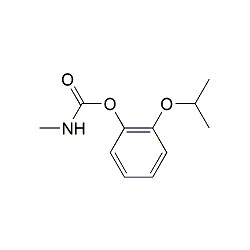 | 672883114-26-1 | 1×250 mg | Bitte anmelden |
ISO 17034 Certified Reference Material PropoxurKonzentration: 10.0 µg/ml Lösungsmittel: Acetonitrile | 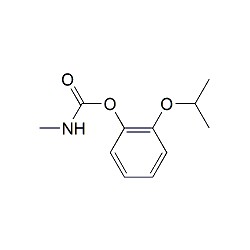 | 673424114-26-1 | 1×10 ml | Bitte anmelden |
ISO 17034 Certified Reference Material PropoxurKonzentration: 100 µg/ml Lösungsmittel: Acetonitrile | 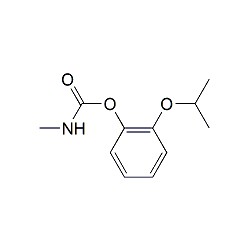 | 673425114-26-1 | 1×5 ml | Bitte anmelden |
ISO 17034 Reference Material D3-Propoxur | 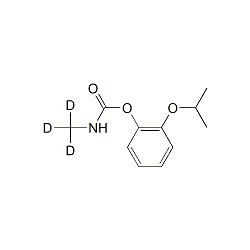 | 6843181219798-56-7 | 1×10 mg | Bitte anmelden |
ISO 17034 Certified Reference Material D3-PropoxurKonzentration: 100 µg/ml Lösungsmittel: Acetonitrile | 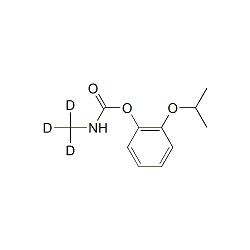 | 6843191219798-56-7 | 1×1 ml | Bitte anmelden |
ISO 17034 Certified Reference Material Propoxur | 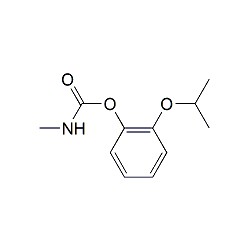 | 691350114-26-1 | 1×100 mg | Bitte anmelden |
Propoxur
High-purity reference materials for accurate and reliable residue analysis.
Overview
Propoxur, also known by its IUPAC name 2-[(Propan-2-yl)oxy]phenyl methylcarbamate, is a carbamate non-systemic insecticide. It is produced from catechol and was introduced in 1959. Propoxur has a fast knockdown and long residual effect, making it effective against a variety of pests.
It is commonly used in turf, forestry, and household pest control, as well as for domestic animals, Anopheles mosquitoes, ants, gypsy moths, and other agricultural pests. Propoxur can also be used as a molluscicide.
Uses
Propoxur is utilized in various applications including:
- Turf and forestry pest control
- Household pest control
- Domestic animal pest control
- Agricultural pest control
- Molluscicide applications
Regulatory
Several U.S. states have petitioned the Environmental Protection Agency (EPA) to use propoxur against bedbug infestations. However, the EPA has been reluctant to approve indoor use due to potential toxicity to children after chronic exposure.
Monitoring
Monitoring of propoxur residues is essential to ensure compliance with regulatory limits. Laboratories conducting food and environmental analysis rely on high-purity reference materials to achieve accurate and reliable results.
Health Impact
Propoxur is a cholinesterase inhibitor, which means it kills insects by irreversibly inactivating the enzyme acetylcholinesterase. This mechanism of action can also pose health risks to humans, particularly with chronic exposure.
Environmental Impact
Propoxur rapidly breaks down in alkaline solutions. It is highly toxic to many bird species, although toxicity varies by species. It is also highly toxic to honeybees and moderately to slightly toxic to fish and other aquatic species.
Safety Measure
Proper safety measures should be taken when handling propoxur. The National Institute for Occupational Safety and Health (NIOSH) recommends a Time-Weighted Average (TWA) exposure limit of 0.5 mg/m3. There are no permissible exposure limits (PEL) set by NIOSH.
Analytical Standards
HPC Standards GmbH provides high-purity reference materials for propoxur, ensuring accurate and reliable residue analysis. Our products are tested according to international quality requirements and meet the highest industrial standards. These reference materials are essential for laboratories conducting food and environmental analysis to ensure compliance with regulatory limits.